Total Pageviews

Saturday, July 16, 2011

Swimming and Stress!


When Will Runners and Swimmers Reach Their Physical Limit?
ScienceDaily (Dec. 23, 2010) — Running and swimming records are broken again and again at almost every international athletics event. But, can human performance continue to improve indefinitely? Will runners continue to accelerate off the starting blocks and reach the finish line in faster and faster times? Will swimmers always be able to dive into the record books with a quicker kick?

Writing in the International Journal of Applied Management Science, researchers from South Korea have analyzed data from sports events over the last one hundred years and have calculated that we could reach the upper limits on elite human performance within a decade.
Yu Sang Chang and Seung Jin Baek of the KDI School of Public Policy and Management in Seoul used non-linear regression models to accurately extrapolate the data from 61 running and swimming events. They have found the "time to limit" to be somewhere between 7.5 and 10.5 years. So, we may still see records being broken at the 2012 Olympics in London and perhaps at Rio 2016, but after that...who knows? The researchers believe their discovery of a "time to limit" has a number of policy implications for the local and national sport associations as well as for the international rule-setting federations.
Of course, US swimmer, Michael Phelps famously proclaimed that, "You can't put a limit on anything. The more you dream, the farther you get." Phelps has set around 40 world records. Sprinter Usain Bolt of Jamaica, similarly shaves split seconds from his 100-metre time almost every time he runs. Countless researchers have previously suggested that humans have a performance limit, Bolt's 9.58 second 100m shattered the previous theoretical running speed limit of 9.60s suggested 40 years ago.
"The limit of speed in sport events has been a popular topic for the public because watching athletes setting new records to win is exciting and stimulating for many sport fans," Chang and Baek suggest. "In addition, setting new world records may even be inspiring to the public because the process of improving and winning the competition reminds them of what they can accomplish in their own life."
Other researchers have criticized the use of linear regression to extrapolate to a limit. However, the present work uses the officially recognized world records on 61 sporting events during the period from 1900 to 2009. (29 running and 32 swimming events all at the Olympic level. "Therefore, this study may be the most comprehensive study undertaken so far," the researchers say. Their statistical analysis suggests that improvements in running and swimming are slowing down and will eventually reach a maximum in the time period they suggest. However, their analysis does not take into account changes in the rules, measurements, and environmental conditions. If the governing federations move the starting blocks as it were, Phelps' prediction that there are no limits may come true and athletes will continue to make a splash in the record
Stress Can Enhance Ordinary, Unrelated Memories

Study about Stress:
ScienceDaily (Dec. 22, 2010) — Stress can enhance ordinary, unrelated memories, a team of neuroscientists has found in a study of laboratory rats. Their results, which appear in the journal PLoS Biology, may bolster our understanding of post-traumatic stress disorder (PTSD) and could offer a pathway for addressing PTSD and related afflictions.

The study was conducted by researchers at the Czech Republic's Academy of Sciences, the State University of New York (SUNY) Downstate Medical Center, and Rockefeller University.
"Our results show that stress can activate memory, even if that memory is unrelated to the stressful experience," explained André Fenton, the study's lead author and a professor at New York University's Center for Neural Science.
"Additional investigations into the effects of stress on memories could shed light on PTSD and other stress-related mood disorders," added Fenton, who directed the studies while he was a Research Scientist in the Czech Republic and an associate professor of physiology and pharmacology at SUNY Downstate.
The study's other authors are: Karel Ježek of the Czech Republic's Academy of Sciences; Benjamin Lee and Eduard Kelemen of SUNY Downstate; and Katharine McCarthy and Bruce McEwen of Rockefeller University.
A common feature of PTSD and various mood and anxiety disorders is the formation of negative associations from otherwise innocuous stimuli or the recall of negative memories stimulated by unrelated, neutral circumstances. What's less clear is how stress influences these phenomena.
To explore the impact of stress on these disorders, the researchers conducted several experiments using laboratory rats.
In these experiments, rats learned to make distinctions between left and right in a T-shaped maze. One day later, the researchers induced stress in the rats through a commonly practiced technique -- placing them in a bucket of water in which they had to swim. Other rats were placed in shallow water, where swimming was not necessary. Subsequent to this procedure, the rats were again tasked with navigating the maze. Their results showed that the rats who had undergone the stressful swim showed better memory for which way to turn in the T-maze than those placed in shallow water.
To test the validity of their findings -- that the memory for navigating the maze was enhanced by the stressful swim and not other forces -- the researchers conducted a series of additional experiments. These procedures ruled out that learning the maze itself was a source of stress and showed a clear link between the stress induced by the swim and changes in the memories of navigating the maze, even though the changed memories were unrelated to the stressful experience.
These results show that stress can reactivate unrelated memories, leading the authors to hypothesize that, in humans, traumatic stress might reactivate non-traumatic memories and link them to the traumatic memory, thereby facilitating the pathological effects seen in post-traumatic stress disorder and other conditions


Credits: Science Daily

Do you believe in a "block" that swimmers will face in their lifetime when they just can't get any faster? How close do you think you are to that block?
 

Thursday, July 14, 2011

Alcohol Hurts

Researchers released the latest findings on such negative effects of alcohol during a meeting Nov. 19 of the Alcohol and Immunology Research Interest Group, held at Loyola University Medical Center.

ScienceDaily (Nov. 11, 2010) — Alcohol can do much more harm to the body than just damaging the liver. Drinking also can weaken the immune system, slow healing, impair bone formation, increase the risk of HIV transmission and hinder recovery from burns, trauma, bleeding and surgery.
At Loyola, about 50 faculty members, technicians, post-doctoral fellows and students are conducting alcohol research. Studies at Loyola and other centers could lead to therapies to boost the immune system or otherwise minimize the effects of alcohol, said Elizabeth J. Kovacs, PhD, director of Loyola's Alcohol Research Program and associate director of Loyola's Burn & Shock Trauma Institute.
"Of course, the best way to prevent the damaging effects of alcohol is to not drink in the first place," Kovacs said. "But it is very difficult to get people to do this."
Sessions at the conference included Alcohol and Infection, Alcohol and Oxidative Stress and Alcohol and Organ Inflammation. Findings were presented by researchers from centers around the country, including Loyola, Cleveland Clinic, University of Iowa, University of Colorado, University of Massachusetts, Mississippi State University, Chicago State University and the National Institute on Alcohol Abuse and Alcoholism (NIAAA).
The conference was supported by Loyola's Alcohol Research Program and Department of Surgery at Loyola University Chicago Stritch School of Medicine, the Society for Leukocyte Biology and the NIAAA

ScienceDaily (Oct. 20, 2010) — There has been an abundance of research on the effects of alcohol on the brain, but many questions regarding how alcohol impairs the built-in control systems are still unknown. A new study released in the January 2011 issue ofAlcoholism: Clinical & Experimental Research, which is currently available at Early View, explores that subject in detail and found that certain brain regions involved in error processing are affected more by alcohol than others.
According to Beth Anderson, a postdoctoral fellow at the Olin Neuropsychiatry Research Centre at Hartford Hospital in Connecticut and lead author of the paper, this research is only the first step in a much larger process."Alcohol is widely consumed in our society today. We know it alters behavior, but surprisingly it is not well studied at the brain level. Once we understand how it is altering the brain, we can better inform the public of the consequences of drinking alcohol."
The researchers gave 38 volunteers different doses of alcohol to establish a breath alcohol concentration of zero for the control group, 0.05 per cent for moderate intoxication, or 0.1 per cent for a high level of alcohol intake. Then, once the alcohol was given enough time to cause intoxication, the volunteers participated in a Go/No-Go reaction test, where either the letters "K" or "X" were displayed on a screen with specific instructions to only press a button when an "X" was displayed.
In the experiment, there was no significant data between the control and moderate intoxication, but there were some very interesting results discovered between the control and high dose testing. After receiving the highest level of alcohol, individuals were found to have an increased reaction time, more errors and an overall decrease of successful trials.
According to Anderson, the lack of data regarding the moderate doses of alcohol was likely due to the fact that the participants were able to partially compensate for the effects of the alcohol. However, following the higher dose, individuals would have had a much more difficult time achieving that. "The increased reaction time was likely an attempt to compensate for their impairment. They may have slowed down in an attempt to keep from making more errors."
However, these results still yield more questions regarding the mystery of how alcohol impairs the control centers of the brain, and only more research will be able to help solve this complicated problem.
"We know [alcohol] alters behavior, but surprisingly, it is not well studied at the brain level," Anderson said. "Once we understand how it is altering the brain, we can better inform the public of the consequences of drinking alcohol.

When have you first started drinking? What brought you into drinking? What do you feel about it now after reading this post? Do you know people who are heavy drinkers and have the symptoms of the latter?
 

Tuesday, July 12, 2011

Top News :Enhance Romance by Going out With Other Couples

A study was conducted in Feb 2011

 Romantic relationships often start out as enjoyable or even exciting, but sometimes may become routine and boring. A Wayne State University study reveals that dating couples that integrate other couples into their social lives are more likely to have happy and satisfying romantic relationships. 

Richard B. Slatcher, Ph.D., assistant professor of psychology in WSU's College of Liberal Arts and Sciences and a resident of Birmingham, Mich., specializes in social and health psychology. His recent research suggests that spending quality time with other couples may be an important way to improve long-term dating relationships.
His study, "When Harry and Sally met Dick and Jane: Experimentally creating closeness between couples," which recently appeared inPersonal Relationships, investigated 60 dating couples in a controlled laboratory setting. The object was to better understand how friendships between couples are formed, and to learn how these friendships affected each couple's romantic relationship.
Each couple was paired with another couple and given a set of questions to discuss as a group. Half of the groups were given high-disclosure questions intended to spark intense discussion, while the other half were given small-talk questions that focused on everyday, unemotional activities.
"In this study, we discovered that those couples who were placed in the "fast friends" group felt closer to the couples they interacted with, and were more likely actually to meet up with them again during the following month," said Slatcher. "We also learned that these same couples felt that this friendship put a spark in their own relationships, and they felt much closer to their romantic partners."
The couples in the high-disclosure group reported greater increases in positive feelings after the intense interaction. They also felt the interaction was more novel and that they learned new things about their romantic partner compared to couples in the small-talk group. In addition, one-third of the couples in the high-disclosure group contacted the other couple they met in the study, while none of the couples in the small-talk group initiated contact with the couple they had met.
"This study suggests that if your romantic relationship has a case of the doldrums, having fun with another couple may help
By going out with other couples, our romance may be enhanced! It is apparent that the romance may burn out quickly. What do you guys think about this new find? Do you think it is necessary to "spice" up your romance? 

Monday, July 11, 2011

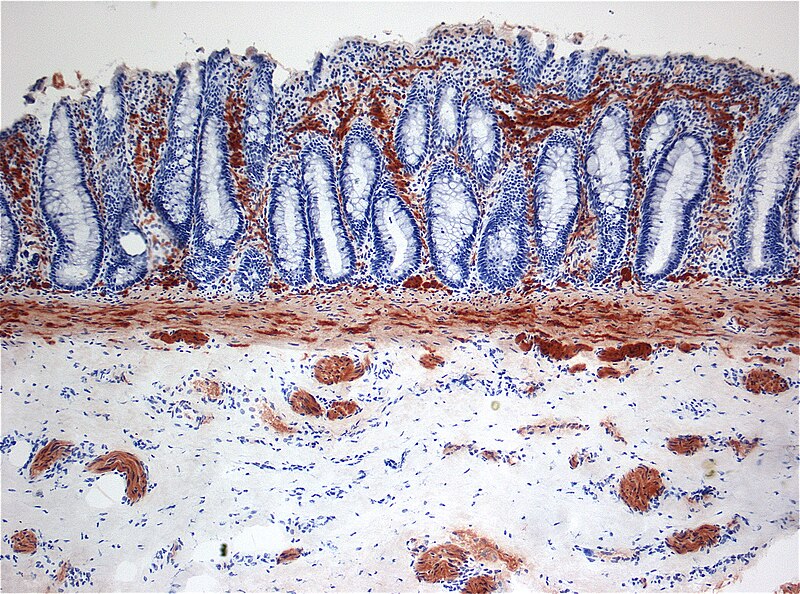
Histopathology of Hirschsprung disease.Enzyme histochemistry showing aberrant acetylcholine esterase (ACHE)-positive fibres (brown) in the lamina propria mucosae.


I had Hirschsprung disease. I don't remember it, but I had it. My parents tell me that when I was only a few years old, I had to undergo a big surgery operation. I have scars from it around my stomach, but I don't remember a single thing about it.

Apparently, only 14 out of 100,000 people receive it. I was one of those lucky winners. As Wikipedia does a general introduction of the subject: 
Hirschsprung's disease (HD), or congenital aganglionic megacolon, involves an aganglionic section of bowel[1] (the normal enteric nerves are absent) that starts at the anus and progresses proximally. The length of bowel that is affected varies but seldom stretches for more than about 30 cm. It arises when certain nerve cells in the gut (called ganglion cells) fail to develop and mature correctly. The result is a section of bowel that is essentially paralyzed.
There is also a limited amount of ways to treat this:
Treatment of Hirschsprung's disease consists of surgical removal (resection) of the abnormal section of the colon, followed by reanastomosis. There used to be two steps typically used to achieve this goal.
    • The first stage used to be a colostomy. When a colostomy is performed, the large intestine is cut and an opening is made through the abdomen. This allows bowel contents to be discharged into a bag.
    • Later, when the child’s weight, age, and condition is right, a pull-through procedure is performed.
Orvar Swenson, the same man who discovered the cause of Hirschsprung’s, first performed it in 1948.[14] The pull-through procedure repairs the colon by connecting the functioning portion of the bowel to the anus. The pull through procedure is the typical method for treating Hirschsprung’s in younger patients. Swenson devised the original procedure, but the pull-through surgery has been modified many times.
The Swenson, Soave, Duhamel, and Boley procedures all vary slightly from each other:
    • The Swenson procedure leaves a small portion of the diseased bowel.
    • The Soave procedure leaves the outer wall of the colon unaltered. The Boley procedure is just a small modification of the Soave procedure. The term "Soave-Boley" procedure is sometimes used.[15][16]
    • The Duhamel procedure uses a surgical stapler to connect the good and bad bowel.
Of those 15% of children who do not obtain full control, various other treatments are available. If constipation is the problem then usually laxatives or a high fiber diet will overcome the problem. If lack of control is the problem then a stoma may be necessary. The ACE or Malone is also an answer. This is where a tube goes through the abdominal wall to the appendix, or if available, to the colon. Then once a day the bowel is flushed. Children as young as 6 do fine with administering this on their own.
If the affected portion of the lower intestine is restricted to the lower portion of the rectum, other surgical procedures, such as the posterior rectal myectomy, can be performed. 


As you can see, the Duhamel producer uses a surgical stapler to connect the good and bad bowel. But, in contrast, the Soave procedure leaves the outer wall of the colon unaltered. The Boley procedure is just a small modification and thus the "Soave-Boley" procedure is sometimes used. If the procedures and such do not come out to become successful, careful measures must be taken. A Stoma becomes necessary. 


What are the symptoms of Hirschsprung's disease?

Eighty percent of children with Hirschsprung's disease show symptoms in the first 6 weeks of life. Children who only have a short segment of intestine that lacks normal nerve cells may not show symptoms for several months or years. The following are the most common symptoms of Hirschsprung's disease. However, each individual may experience symptoms differently. Symptoms may include:
  • not having a bowel movement in the first 48 hours of life
  • gradual bloating of the abdomen
  • gradual onset of vomiting
  • fever
Children who do not have early symptoms may also present the following:
  • constipation that becomes worse with time
  • loss of appetite
  • delayed growth
  • passing small, watery stools
Symptoms of Hirschsprung's disease may resemble other conditions or medical problems. Please consult your child's physician for a diagnosis.


As a conclusion, it is fatal for parents and nurses to take the full measures of diagnosing a newborn child. Due to unknown reasons, the symptoms Hirschpung disease may appear. Medical assessments are absolutely necessary! Please, if you know the parents of a newborn, be sure to tell them!

Sunday, July 10, 2011

Medical Change

Hello Reader,

For a while now I've been contemplating the subject of my blog. So far it has been split into two broad sections of learning and yearning. I have decided to change my blog into a more scientifically oriented area.

With that said, I will provide medical information for all types of situations. More geared to the mind and brain, information about disorders and psychology will be given.

Today I will be writing about Mad Cow Disease. 
ScienceDaily (Jan. 11, 2011) — Scientists at the University of Kentucky have discovered that plasminogen, a protein used by the body to break up blood clots, speeds up the progress of prion diseases such as mad cow disease.
As you can see, this study is very recent.


This finding makes plasminogen a promising new target for the development of drugs to treat prion diseases in humans and animals, says study senior author Chongsuk Ryou, a researcher at the UK Sanders-Brown Center on Aging and professor of microbiology, immunology and molecular genetics in the UK College of Medicine.
"I hope that our study will aid in developing therapy for prion diseases, which will ultimately improve the quality of life of patients suffering from prion diseases," Ryou said. "Since prion diseases can lay undetected for decades, delaying the ability of the disease-associated prion protein to replicate by targeting the cofactor of the process could be a monumental implication for treatment."
The study was reported in the December issue of The FASEB Journal, published by the Federation of American Societies for Experimental Biology.
Ryou's team used simple test-tube reactions to multiply disease-associated prion proteins. The reactions were conducted in the presence or absence of plasminogen. They also found that the natural replication of the prions was stimulated by plasminogen in animal cells.
"Rogue prions are one of nature's most interesting, deadly and least understood biological freak shows," says Dr. Gerald Weissmann, editor-in-chief of The FASEB Journal. "They are neither virus nor bacteria, but they kill or harm you just the same. By showing how prions hijack our own clot-busting machinery, this work points to a new target for anti-prion therapy."
According to the U.S. National Institute of Allergy and Infectious Diseases, prion diseases are a related group of rare, fatal brain diseases that affect animals and humans. The diseases are characterized by certain misshapen protein molecules that appear in brain tissue. Normal forms of these prion protein molecules reside on the surface of many types of cells, including brain cells, but scientists do not understand what normal prion protein does. On the other hand, scientists believe that abnormal prion protein, which clumps together and accumulates in brain tissue, is the likely cause of the brain damage that occurs. Scientists do not have a good understanding of what causes the normal prion protein to take on the misshapen abnormal form.
Prion diseases are also known as transmissible spongiform encephalopathies, and include bovine spongiform encephalopathy ("mad cow" disease) in cattle; Creutzfeldt-Jakob disease in humans; scrapie in sheep; and chronic wasting disease in deer and elk. These proteins may be spread through certain types of contact with infected tissue, body fluids, and possibly, contaminated medical instruments.
The co-author of the study is Charles E. Mays, formerly a graduate student in the Ryou lab 
I'm sure we all remember that time when Mad Cow disease was of extreme relevance. But little did we know that research is still conducted on the subject. 


Even though the disease has settled down considerably, study is still focused to develop medicine that can improve the quality of life for patients suffering from related diseases. 


Prions can turn a normal protein into a misfolded form. One prion in mammals promotes progressive neurodegenerative disorders like "mad cow" disease that often prove fatal. But how this process happens remains an open question for scientists.
Prions have been found to exist in a wide range of organisms. Those in brewer's yeast, which researchers like Liebman study, provide critical insight into how prions work.
Prion proteins in yeast aggregate, while non-prion proteins do not. Aggregation of new prions happens spontaneously -- but, in the natural world, very slowly.
Anita Manogaran, a former UIC research assistant professor in biological sciences, working with Liebman, sped-up prion formation to identify genes important in the process. The researchers were also able to monitor different stages of prion appearance by tagging prion proteins with another protein that fluoresces green. Cells in the process of forming prions had fluorescent rings, which could give rise to cells with prions.
"We learned there are some genes important for the generation of prions," Liebman said.
Some 400 yeast genes were screened for the ability to prevent the new appearance of yeast prion proteins.
"Through a number of screens, we came down to a much smaller number (of genes) that inhibited prion appearance," Liebman said. These genes fell into two classes -- one that could still make the rings, which is the hallmark of the beginning of prion aggregation. But the other class of genes had trouble forming rings, Liebman said.
Liebman and Manogaran also looked beyond new prion formation to see if these same genes had an effect on toxicity associated with a protein that causes Huntington's disease -- a fatal human neurodegenerative disorder.
"We found that genes that could make rings also were more toxic in the presence of the Huntington's disease protein," Liebman said. "If no rings were made, they were less toxic."
The full implications of the findings are not yet understood, Liebman cautioned.
"The more we understand about these mechanisms and the genes that are involved, the more we'll be able to understand the new appearance of prion disease -- like Creutzfeldt-Jakob and 'mad cow' -- and Huntington's disease. The more we understand what affects toxicity, the more we'll understand why these are toxic."
The findings were reported in the May 19 issue of PLoS Genetics.
Manogaran, now at the University of Wisconsin-Milwaukee, UIC research assistant Joo Hong and former UIC undergraduate student Joan Hufana worked with Liebman on the project. Other co-authors of the paper include Jens Tyedmers of the University of Heidelberg and Susan Lindquist of the Massachusetts Institute of Technology.

As you can see here, more findings are being made. Thank you for reading. Please, if I may, what are your thoughts of researching diseases that are not of extreme relevance? Do you think they are an efficient way to use money? In these economic times, is it necessary to spend the money on such diseases? 

Saturday, July 9, 2011

Yearning: a power to change


And suddenly, I found myself in a brawl. Guns out and knives were wielded. 

It's strange how one finds himself trapped in a situation where he is limited by the amount of actions he can act upon. In my case, I was in a argument with a family member that led to death. Of course, it didn't lead to the death of a human, but to an endeavor. An endeavor to help. 

It's a strange feeling knowing that you had the ability to help someone a few years ago, but since you didn't, the problem grew into something bigger. And now, the little problem that was a seed, he is engulfed by the spicy venom.

It's a sad feeling.

Friday, July 8, 2011

Learning: Honey Mustard Dressing & Salad Dressing


Honey Mustard Dressing II and Scrubby Bear's Own : random salad dressing


Cup Noodles? Check! Costco rotisserie chicken? Yes. Salad? :)  .... Sauce and salad dressing? :(

I took it upon myself to make myself a delicious and unhealthy meal. The clock was ticking and I had plans for the rest of the day, and I thought I was done making lunch after the water boiled and the chicken was sliced. 


 Literally my "salad"


After taking a deep breath of the delicious aroma of cheap noodles and chicken, I was ready to feast. As the soft noodles and roasted chicken skin dangled off the chopsticks in my mouth, I noticed there was something terribly wrong. 
Me thinking about what was missing
After pondering for a while, I figured it out. The missing gear to the grand lunch was salad dressing and some sexy sauce for the chicken. 

I figured it out:

Honey Mustard Dressing II

By: Mary Ann Benzon 

Ingredients

  • 1/4 cup mayonnaise
  • 1 tablespoon prepared mustard
  • 1 tablespoon honey
  • 1/2 tablespoon lemon juice

----- mine tasted straight up creamy and sweet.. with a bit of mustard taste. 

Scrubby Bear Random Salad Dressing:

  • 1 cup extra virgin olive oil
  • 1/2 cup white wine vinegar
  • 3 tablespoons of honey
  • 1/4 cup ketchup
  • 1 teaspoon salt
  • 2 teaspoons Lemon Juice
2 cloves garlic, minced
3 tablespoons dried parsley 
2 tablespoons paprika
1.5 tablespoons ground pepper 

Vigorously shake that.
--------should taste spicy, tangy, slightly salty, tiny bit sour, and sweet. 


After about 20 minutes of synthesizing the final ingredient to my 5 star lunch, I was to lazy too eat anything and wrote this blog.

Enjoy ;)